

When the Wolves Guard the Gate
How the Insurance Industry Is Quietly Deciding Which Churches Get to Live

“We paid faithfully for years. One storm hit, one claim, one sigh of relief—and then the letter came: ‘We will not be renewing your policy.’ What happened to my church isn’t an anomaly. It’s a symptom of a system quietly abandoning the very communities it profits from.”
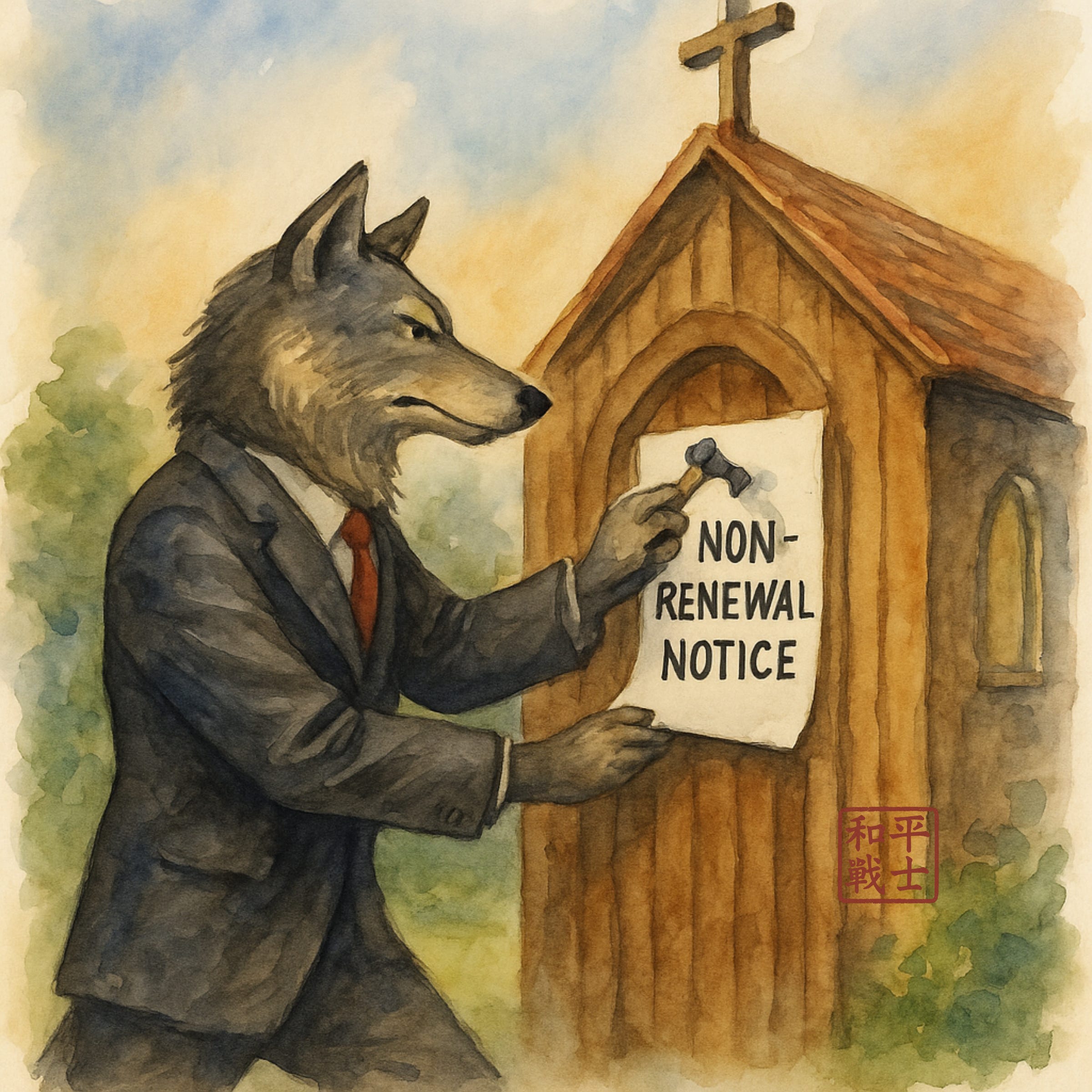
For years, my church paid over $6,500 annually for property insurance.
One claim. Just one.
A weather event—an act of God—the kind of thing insurance literally exists to cover.
And then?
Non-renewed. Dropped. Evicted from our own safety net.
Don’t insult my intelligence: this wasn’t about “risk management.”
This was about us.
About the kind of church we are.
About the people we shelter, the people we serve, the people we refuse to abandon.
Ever since Mother Emanuel AME, it has become dangerous to be a house of worship that stands with those white supremacy hates. Churches with multicultural membership, LGBTQ inclusion, immigrant ministries, sanctuary work, or visible social justice commitments are living under a violent shadow.
Insurance companies see that shadow too.
And they don’t like it.
They like clean risk profiles. Predictable numbers. Quiet congregations.
What they do not like are churches that live the Gospel without fear.
And so insurers are quietly doing what Christ never did: walking away.
Even Allstate forgives the first accident.
But when a church forgives the stranger?
When a congregation opens its doors wide?
When ministry becomes refuge?
The insurance world shrugs:
“You’re on your own.”
Before I go any further, let me be clear and fair:
No, we don’t have internal memos or whistleblowers confirming discrimination.
But what we do have is a rapidly growing mountain of structural data, federal investigations, industry analyses, and clergy testimony showing that insurers across the country are dropping churches at historic levels—even those with no claims.
What’s happening is bigger than any isolated situation.
It’s a pattern.
And patterns tell the truth.
The Data Doesn’t Lie: Nonrenewal Is the New Business Model
Major investigations from Public Citizen, the Senate Budget Committee, Brookings Institution, Moody’s, and multiple consumer groups tell the same story:
“Insurers have begun to rely on nonrenewals and cancellations as key levers to manage risk.”
—Public Citizen, Mapping the Home Insurance Crisis (2024)“Nonrenewal rates have surged, especially in counties viewed as ‘high-risk.’”
—U.S. Senate Budget Committee report (2024)“In ZIP codes with elevated projected risks, nonrenewal rates were 80% higher.”
—Brookings analysis of NAIC / FIO dataset (2025)
Those numbers describe a national market pulling back from anything it deems risky.
But here’s the hidden truth:
Insurers define “risk” far more broadly than storms and fires.
They factor in:
social volatility
demographic shifts
hate-crime statistics
public-gathering exposure
political climate
litigation risk
aging buildings
community profile
Churches are on the wrong side of almost all of those—not because of wrongdoing, but because of who we are and who we love.
What Clergy Across the Country Are Saying: A Nationwide Pattern Emerges
To test whether our experience was unusual, I ran a poll in two United Methodist clergy groups. The results came in fast — faster than I expected — and what they reveal is staggering.
Poll Results (119 total votes across two clergy groups)
United Methodist Clergywomen (UMCW): 37 votes
Same rate/deductible: 9%
Renewed, higher rate & deductible: 63%
Not renewed, no claims: 10%
Not renewed, with claim: 10%
United Methodist Clergy (UMCC): 82 votes
Same rate/deductible: 7%
Renewed, higher rate & deductible: 65%
Not renewed, no claims: 14%
Not renewed, with claim: 14%
Across both groups, only 7–9% of churches saw stable premiums.
Every other congregation experienced either sharp increases or lost coverage entirely.
And the comments? They paint an even clearer picture.
Here are recurring themes from clergy:
Church Mutual is dropping churches across multiple states, often without claims.
Premiums are doubling, tripling, or quadrupling.
Insurers are refusing to cover historic buildings, regardless of upkeep.
Deductibles — especially wind and roof — are skyrocketing.
Carriers are requiring expensive upgrades just to consider giving a quote.
Some churches are considering going uninsured entirely because coverage is unaffordable.
Several conferences are pursuing conference-wide group policies because individual churches cannot obtain or retain coverage.
Direct clergy experiences:
“Our church and several others were dropped by Church Mutual. Premium more than doubled, and they wanted it paid upfront with 20% interest if not.”
“We went from $45,000 to $90,000 a year and lost $4M in coverage. Only two companies were willing to even talk to us.”
“Dropped for being ‘too old.’ Our building is from 1785. We had 60 days to find coverage.”
“This is a national issue. Conferences are scrambling.”
“Many churches are getting dropped even without claims.”
This is no longer anecdotal.
It’s systemic.
It’s structural.
It’s happening everywhere.
And if insurers can drop any church they consider “too risky,” then we must confront the uncomfortable truth:
Insurance companies are beginning to decide which ministries get to exist.
This Is a Moral Crisis, Not Just a Financial One
Jesus flipped tables when the Temple became a marketplace.
Imagine His response to an industry that profits most from communities in crisis — and then abandons them when the crisis grows.
He would not be polite.
He would not speak in actuarial euphemisms.
He would not tell us to simply “shop around.”
He would say what I’m saying now:
You cannot profit from our faithfulness and then punish us for living it.
Because that’s exactly what is happening.
Churches that:
shelter the vulnerable
host immigrants
support LGBTQ youth
feed the hungry
operate warming centers
serve high-risk communities
stand against bigotry
…are being reclassified as too costly.
As if the Gospel is a liability.
As if love is a threat.
As if we are supposed to choose between ministry and insurability.
I refuse.
And I know I’m not alone.
Where We Go From Here
We do what Christ taught us:
We shine light.
We tell truth.
We gather witnesses.
We resist fear.
We defend the vulnerable.
We refuse the chains that polite society places on radical love.
We refuse to let the wolves guard the gate unchallenged.
And if insurers think they can quietly shape which churches survive,
they’re about to learn something fundamental:
We do not exist because they insure us.
We exist because Christ called us.
And no corporation gets the final say on that.
Sources & Further Reading
If you think this is just one church’s misfortune, it isn’t. Across the country insurers are dropping longtime customers at historic levels. The pattern is documented by federal investigators, economists, consumer watchdog groups, and journalists. Here are some of the most credible recent sources showing what’s happening and why it matters.
(for readers who want to explore the broader data)
Public Citizen — “Mapping the Home Insurance Crisis” (2024)
https://www.citizen.org/article/mapping-the-home-insurance-crisis/
U.S. Senate Budget Committee — “New Data Reveal Climate-Change-Driven Insurance Crisis Is Spreading” (2024)
https://www.budget.senate.gov/chairman/newsroom/press/new-data-reveal-climate-change-driven-insurance-crisis-is-spreading
Brookings Institution — “Homeowners Insurance in an Era of Climate Change” (2025)
https://www.brookings.edu/articles/homeowners-insurance-in-an-era-of-climate-change/
Moody’s CRE — “New Data on Insurance Nonrenewal Rates, Claims, and Premiums” (2025)
https://www.moodyscre.com/insights/cre-trends/new-data-on-insurance-nonrenewal-rates-claims-and-premiums/
InsuranceNewsNet — “In Vulnerable Areas, Climate Risk Drives Home Insurance Non-Renewals” (2025)
https://insurancenewsnet.com/oarticle/in-vulnerable-areas-climate-risk-drives-home-insurance-non-renewals-not-just-rate-hikes-insurify
J.P. Morgan Private Bank — “How Climate Risk and Losses Are Creating High Prices for Home Insurance” (2025)
https://privatebank.jpmorgan.com/nam/en/insights/markets-and-investing/ideas-and-insights/how-climate-risk-and-losses-are-creating-high-prices-for-home-insurance
Consumer Federation of America — Home Insurance Crisis White Papers (2023–24)
https://consumerfed.org/publications/
ProPublica Insurance Investigations (2024–25)
https://www.propublica.org/
NOAA Severe Weather & Damage Database
https://www.ncei.noaa.gov/access/billions/
Pew Charitable Trusts — “Extreme Weather Is Changing the Insurance Market” (2024)
https://www.pewtrusts.org/
American Academy of Actuaries — Reports on Underwriting & Risk
https://www.actuary.org/